Today’s introductory paragraph of proper and mindless optimism: It’s noon, I’m currently at our local cafe sipping some house roast, and there just so happens to be three huskies to my right, each of their own color and variety, basking in the sunlight. They all have a base of white fur, but their outlines are different – red, brown, and black. They all have bright blue eyes, which contrast well with the orange and yellow leaves dominating the background. Today is a good day.
Hello to you, dear reader! If you’re new to the blog, welcome! Please make yourself at home, get cozy and have some nice hot apple cider as we continue our journey together.
Recap from Last Week:
This past week was the very first in my journey of realizing a pipe dream of becoming an indie game developer. In my first post, I introduced this blog, defined its purpose, and set some goals – namely these goals are to continuously build a set of skills (visual art, pixel art/animation, music composition, story development/world building, and coding C# in Unity), all of which are required in order to craft a videogame from complete scratch.
My first challenge – and somewhat (?) of a solution
The obstacle that I encountered on day one (November 6th, 2023) was finding (any) time to dedicate to learning the skills of indie game development. This is difficult, especially while balancing time between working, studying, and meeting family/friend obligations – this is perhaps a universal challenge that all of us face when initially starting a new project, hobby, or sidehustle. So, how do we overcome it?
Here’s a brief list of potential learning times throughout the average workday: Before work (1-2 hours), while eating breakfast (15-20 minutes), during commute to and from work, lunch break (25-30 minutes), and before bed (30 mins – 1 hour). This adds up to about 2.5 to 3 hours per day that I can dedicate to learning and doing things about game design.
While this schedule sounds pretty straight forward, there was just one problem: for me, personally, it was unrealistic to go from spending zero hours per day of game development straight to 2.5+ hours per day. I tried sticking to that unrealistic schedule, and quickly realized that it was not sustainable – I would be burnt out in no time. So, beginning on Wednesday, I switched to a more realistic goal of 90 minutes per day.
And it worked! With this schedule, I was able to learn (by watching/listening to YouTube videos) for roughly ~50 minutes per day, and dedicate ~40 minutes per day to actually making stuff!
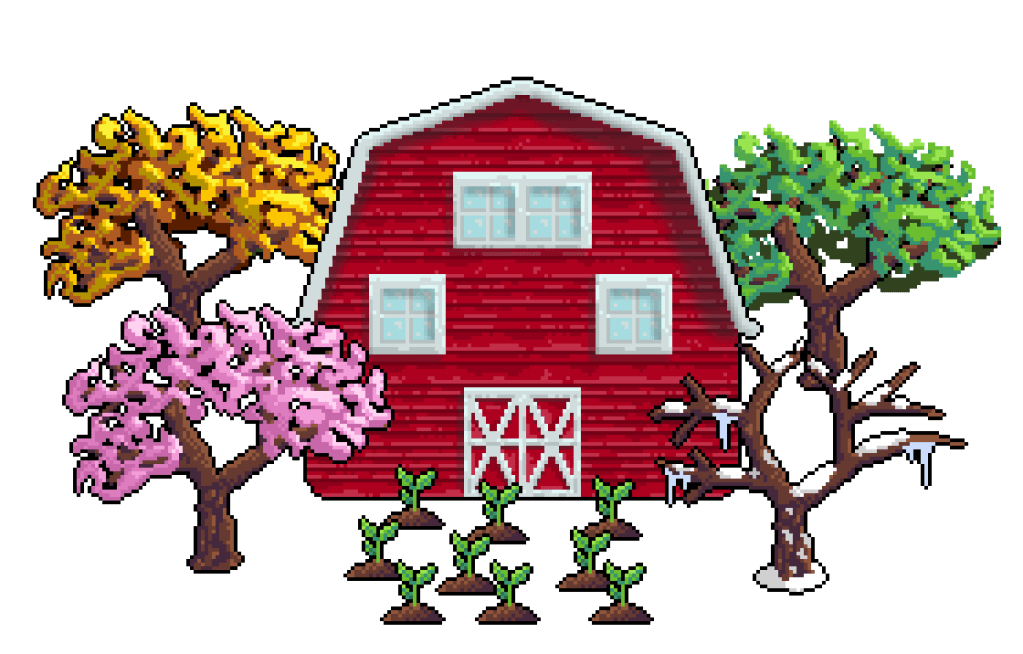
Using an amazing piece of pixel art software called Aseprite (which costs $20 on Steam), this what I was able to make this week:
- A seedling sprouting out of the dirt
- Four trees, one for each season of the year
- A Barn (more specifically, the front of one)
I started off early Monday morning by trying my hand at making one the most basic entities found in any farm simulator game: the sprouting seedling!
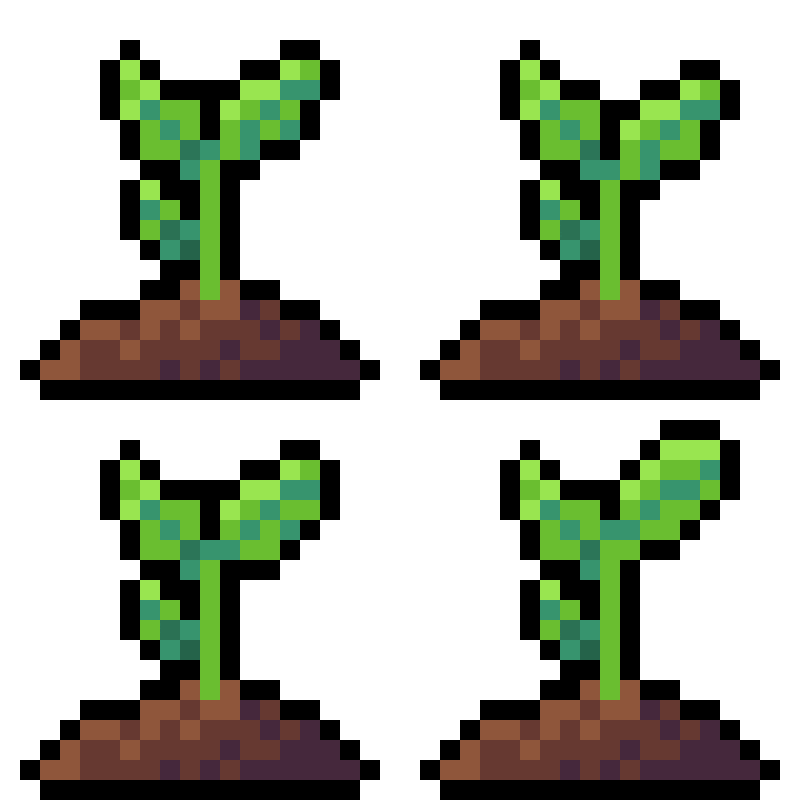
I used a total of 6 shades of green, 3 shades of brown, and a bold black outline to help make the seedling stand out from the background. Finally, I tried animating the leaf to make it look as if it’s gently drifting along with the breeze.
Tuesday morning, I decided the next thing to make would be a tree trunk! Quite quickly, this tree trunk evolved into a lonely tree surviving the harsh, cold winter, covered in snow and dripping with icicles:
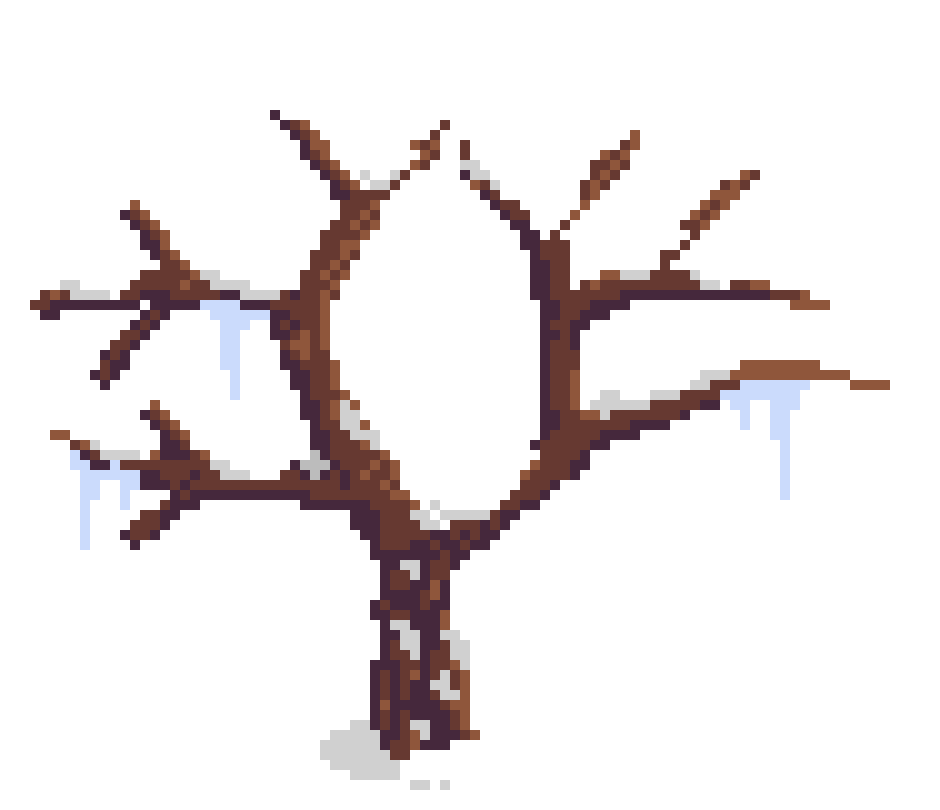
You’ll notice that the snow is actually made up by 2 shades: white and gray. The icicles hanging from the trees consist of a single shade of very pale blue. The trunk is made up of 3 shades of brown, with the darkest being strikingly close to violet, but you don’t notice the violet hue when you look at the entire image – all you see is a nice brown tree trunk. Cool, right?
After making a winter tree, I had absolutely no choice but to make one tree for each season. This was simpler than you’d imagine. I was able to copy and paste the same trunk for each tree, and only draw the leaves once. Then, I could change the color of the leaves depending on the season! For instance, here’s a spring tree (it’s pink hue strikes me specifically as a dogwood tree):
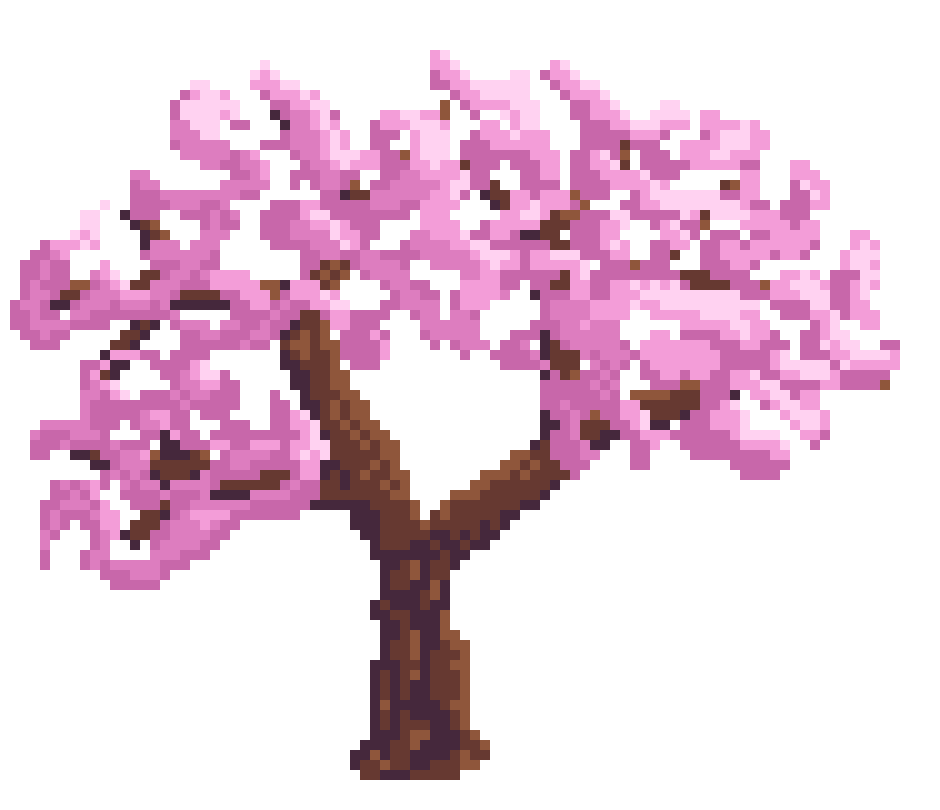
Here’s the summer tree (to give this tree more fullness and depth, I added an underlying background of dark green foliage):

And of course, an autumn tree (saved the best for last):

One way that I hope to improve my tree-drawing in the future is to make the leaves look more like… leaves. In the above images, they kinda look more like whimsical clouds of colorful smoke, ensnaring the branches.
As the weekend approached, I decided to attempt to make my first pixel art building: a barn!
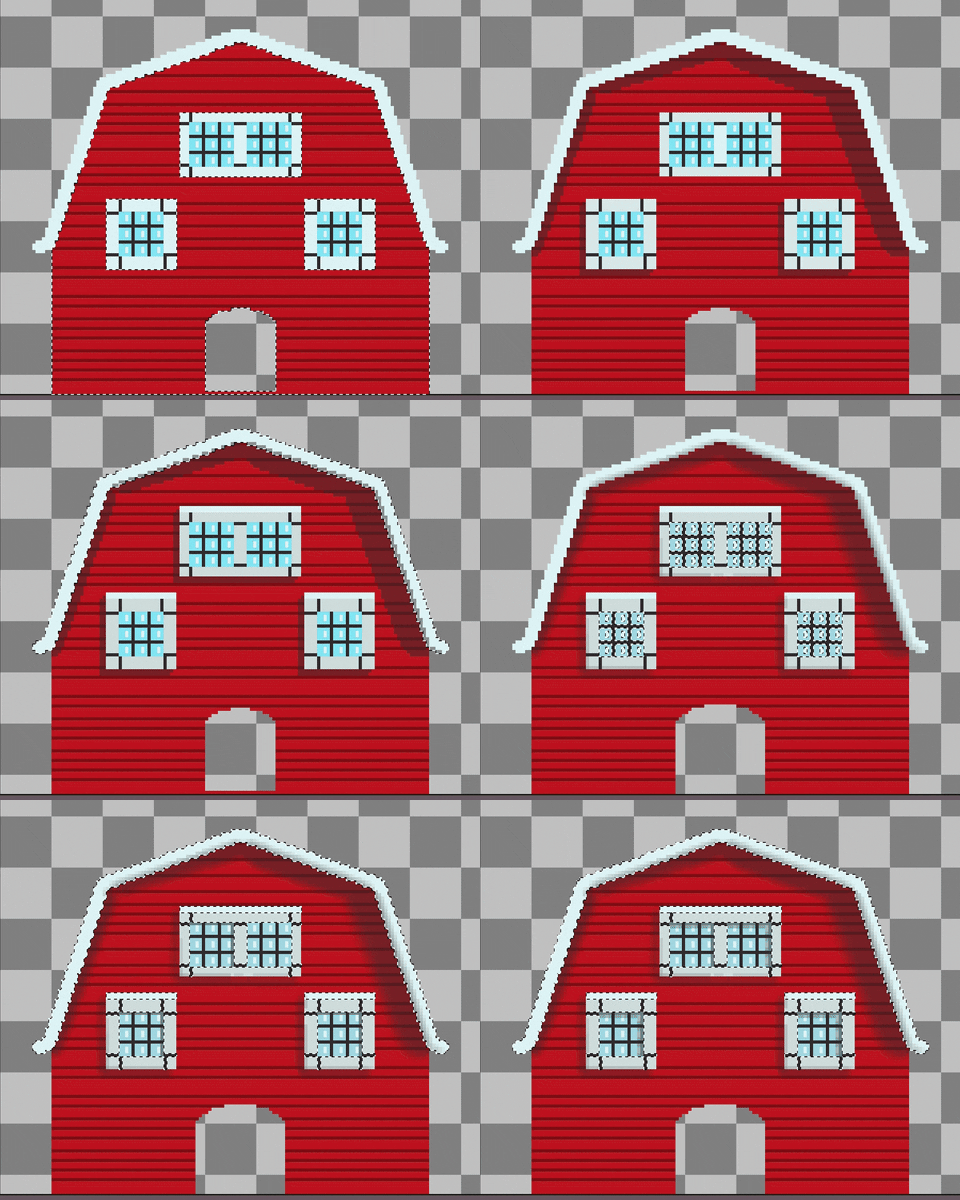
Building the barn was a bit discouraging at first. Rendering the red and white wood, the glass, and the shading was quite difficult. As with real life objects, pixel art objects are made up of materials that have their own textures. Through tiny pixels, it’s actually quite difficult to render real-world materials convincingly.
As you can see below, the barn looked quite terrible at first, with too much solid red and white coloring. I was quite disappointed at this stage.

Then I added some shading by creating a second semi-transparent layer of black. Next, I blurred the edges of the shading to make it look more natural. But even after this phase, the barn still looks dull and overly cartoonish. My suspense of disbelief was still low at this point.
But alas, I found guidance and inspiration! Below is a snapshot from a videogame called Stardew Valley. This game and its creator (Eric Barone) are perhaps the largest inspirations for me to pursue indie game development. Single handedly, Barone crafted all the art, music, story, and code that makes up this farming simulation game, and the final product really couldn’t be more perfect in my opinion. I fell in love with this game back in high school and still play it from time to time to this day, seven years later.
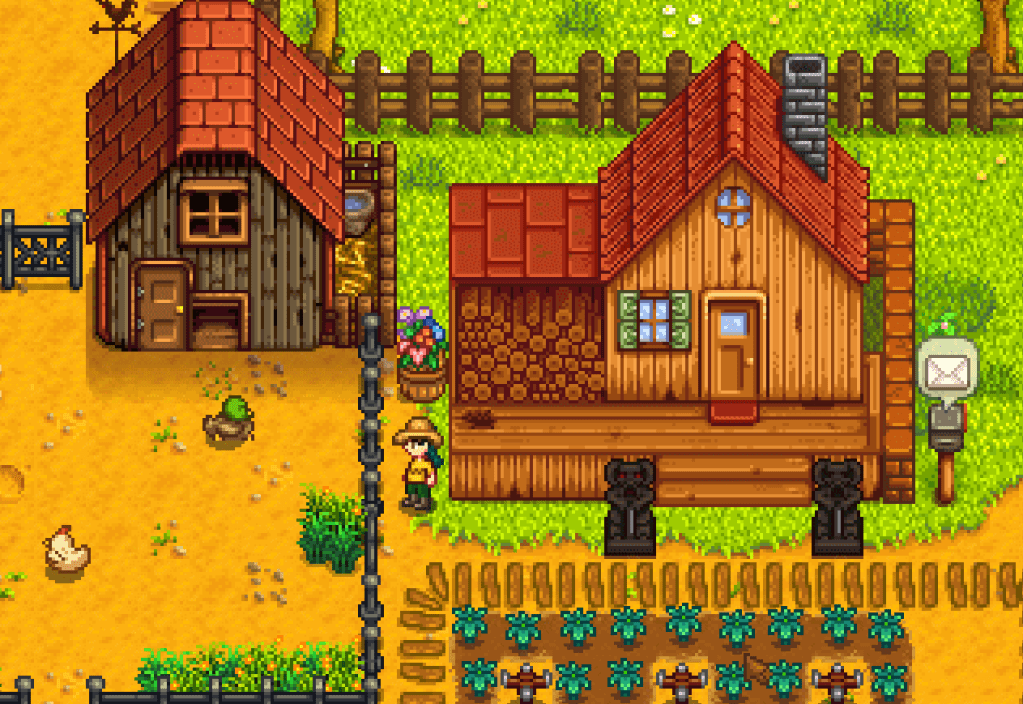
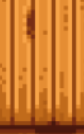
If you look closely at the pixels that make up the wood of the buildings, you’ll notice that each horizontal plank of wood is made up of 3 different shades of brown, and the panels are divided from each other by a one-pixel-wide line of very dark brown. See here more closely:

So, I decided to try and emulate this technique in my barn. First, I picked a shade of red that was slightly darker than my base red, and used this color to create an uneven shadow beneath each horizontal wooden panel. I also added a barn door:
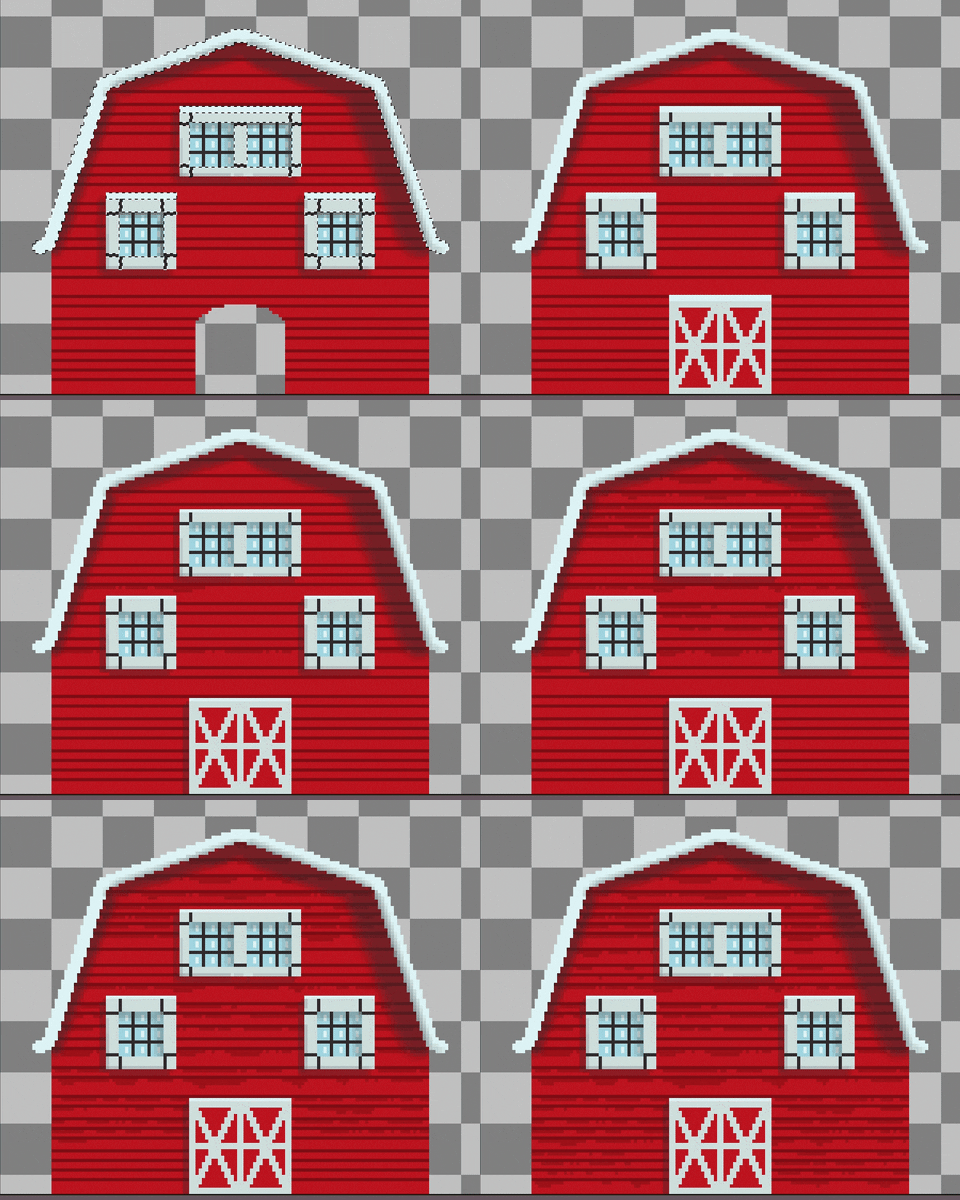
I used an uneven line of shadow assuming that this wood is old and rugged, and perhaps the paint is flaking and uneven, so light would interact in a non-uniform way with each different segment of wood.
Next, I picked a slightly brighter shade of red, and used it to create an uneven line of brightness at the bottom of each panel, as if light was more able to strike the bottom of each wooden panel compared to the middle and top of each panel. I also decided to edit the windows because I didn’t like the black lines, they gave too much contrast with the white window frame. Also by dividing the windows up into 4 glass panes rather than 9, each glass pane became significantly bigger and allowed for more convincing renditions of the glass material:

Next, I added an additional two shades of white (one darker, one lighter) to the white roof and window frames. I then rounded the bottom corners of the barn, another technique used by Barone to convey 3D shape in his 2D buildings. Finally, I rendered the wooden materials in the barn door, and called it a day.

I’m happy with the end product of the front of this barn, but I have yet to really bring this building to life by adding a roof. By extending this image backwards with a proper roof, my hope is that it would feel more like a three-dimensional space rather than a flat image. My hope is to work on that next week!

I’d like to thank you for joining me for another moment here at the Cider Mill. If there’s anything I’ve learned this week, it’s that oftentimes, the biggest barrier in achieving one’s dreams is the barrier to starting! Before you start, it is quite scary – it feels like you’re standing at the edge of a rocky ledge, about to dive into the ocean waters below. It’s a bit intimidating at first, but once you just take the leap, what comes next is quite amazing! Not too long ago, I couldn’t imagine myself taking that leap at all, yet here I am, mindlessly counting the fish underwater, having a blast.
Now, regarding the following quote, I want to clarify that I’m not trying to change the world on a massive scale or anything. To make maybe a ripple in the changing tide would be enough for me. But to celebrate the end of week one, here’s one of my favorite inspirational quotes of all time.
“Here’s to the crazy ones. The misfits, the rebels. The troublemakers. The round pegs in square holes. The ones who see things differently. They’re not fond of rules. And they have no respect for the status quo. You can quote them, disagree with them, glorify or vilify them. About the only thing you can’t do is ignore them. Because they change things. They push the human race forward. And while some may see them as the crazy ones, we see genius. Because the people who are crazy enough to think they can change the world, are the ones who do.”
Steve Jobs
Cheers to our dreams,
Wady


2 responses to “Seedling, Four Trees, and a Barn”
I love the pixel art. Impressive quality for the brief time frame!
LikeLiked by 1 person
Thanks man, I appreciate your feedback! Looking forward to improving and dedicating longer amounts of time to larger works (imagine like a continuous 1-month long project creating an animated seasonal landscape or smth like that).
LikeLike